Understanding Founder’s Syndrome in Social Entrepreneurship
Among social entrepreneurs, there is a special drive to make change in the world. To fulfill a particular social mission while also ensuring that the organization can remain financially viable. There are certain skills that a founder who is starting a social enterprise needs to have. They need courage, a clear vision and the ability to motivate people to understand that vision and support them in creating an organization that fulfills its desired mission. Successful founders at the start-up (founding) stage require these skills to be able to birth their organization. They also need to be able to keep track of all the details of everything going on, especially since social enterprises in their earliest stages of growth are often under-staffed and under-resourced.
In this sense the founder(s) are very much the parents of the organization and, ultimately, the organization can only have one set of parents. Using this analogy, we can also lay out that all parents have a choice in terms of how they will parent their children; they can either raise them to be independent and grow beyond them or they can raise them to always be dependent on them, regardless of their age or level of maturity. In addition to this, organizations can be set up with a certain ethos that holds up even when the founder is not around.
As a qualitative researcher of founder leadership, the people I interview often share incredible insights that summarize well the choices that a founder needs to make in terms of how they will approach the “parenting” of their organization once it is past the founding stage. Here is one example of an interviewee sharing her view of how a founder can lead (parent):
“There are some parents who want their kids to go to Harvard and they want their kids to be bankers, but they don't care if their kid is a fundamentally good person and has good grounds and good morals. I think the right founders continue to care about whether their kid has good morals and whether the world would see them as a good person.”
This analogy illustrates that even though an organization will always have only one set of parents, the way the founder(s) choose to lead (parent) will determine who the organization turns out to be, as well as whether it will be able to stand on its own two feet beyond them. This is where the topic of succession planning becomes very important. In the healthiest founder-led organizations, the founder will have ideas about their future succession during the inception of the organization or soon after. The way an organization grows and develops is directly related to the manner in which the founder and board have prepared for the reality that the founder may exit the organization at some point (for any reason). Founders who value the sustainability of the organization will do everything possible to have a succession plan and take steps to consciously execute it when the time comes, with the support of their board of directors.
On the other hand, in an organization where the founder has Founder’s Syndrome, this intentional succession planning is entirely absent. In this setting, it is very likely that there is no cohesive succession plan and even if there is one on paper, it will not actually be executed.
In most cases, Founder’s Syndrome is not inherently visible until the organization is past the founding stage. This is because the skills that the founder uses to build the social enterprise are distinct from the ones that may be required to sustain and scale it. Thus it is only once the organization is past the founding stage that we can inherently witness whether the founder possesses the primary leadership traits associated with Founder’s Syndrome, which are as follows:
The organization’s image is strongly identified with the founder;
High levels of micromanagement by the founder;
High levels of staff turnover;
The view of the founder is the only view that matters;
Lack of a concrete succession plan for the founder.
In studying Founder’s Syndrome for over a decade, observing organizations across 20 countries and hundreds of settings, I have developed the following definition of the phenomenon:
Founder’s Syndrome is a malady that affects founders who are primarily driven by the need to control, without clear delegation or succession planning, often using defense strategies such as dominance to maintain legitimacy. Within the organization, this often results in dysfunctional leadership and management practices and a social structure that forms around the founder to protect their image in The Public Eye.
The founder’s public image and understanding of their role becomes critical when seeking to recognize Founder’s Syndrome and how it develops. My research has shown that the founder’s self-concept will determine the way they will lead, as well as where they are on the spectrum of Founder’s Syndrome. The key distinction comes in when we examine whether the founder views themselves as more of a founder or more of a leader. If the founder views their primary role as being a founder, then they are more likely to develop Founder’s Syndrome over time. The reason for this is that there are certain societal privileges bestowed upon founders, and founders in this group are driven by attaining them.
All founders, including social entrepreneurs, are put in a class that is viewed societally as being elevated above the average human. My research has also uncovered that most founders that think of themselves as a founder only are first time founders, who have continued to lead their organization over the long-term. As founders with this view continue to lead their organization, their image continues to be closer and closer intertwined with the brand of the organization, until there is no distinction between the founder and the organization itself. Furthermore, the grander their image grows, the more the founder can become personally attached to it. In essence, it is akin to believing your own press. As a consequence of wanting to maintain and control their public image, a social structure develops around the founder to protect the image they have developed and carefully crafted.
Within this, there is often a small group of people who form the inner circle who have been working with the founder for a long time (likely since the organization’s inception) and these people will provide the founder with ongoing unwavering loyalty above all else. They will also not go against the founder’s views or challenge them on their decisions. If the board of directors that the founder has selected has similar traits, there is virtually no chance that the founder will be held accountable for their leadership decisions.
So much of Founder’s Syndrome comes down to a personal lack of self-awareness and an inherent inability to move out of the way as a leader so that the organization they lovingly birthed can breathe and grow beyond them. Like thoughtful parenting, it involves releasing control and a good deal of trust and faith in other people.
Unless a founder cultivates this type of outlook and continues to check in with themselves and others about whether they are still the right leader for their evolving organization, the effects of Founder’s Syndrome will continue to prevail.
As a founder, accepting that you might not have all the answers and that true leadership involves receiving support from various sources will help to continue to infuse your organization with the energy it needs to thrive and remain agile.
Just remember: if you think you have Founder’s Syndrome, you most certainly don’t.
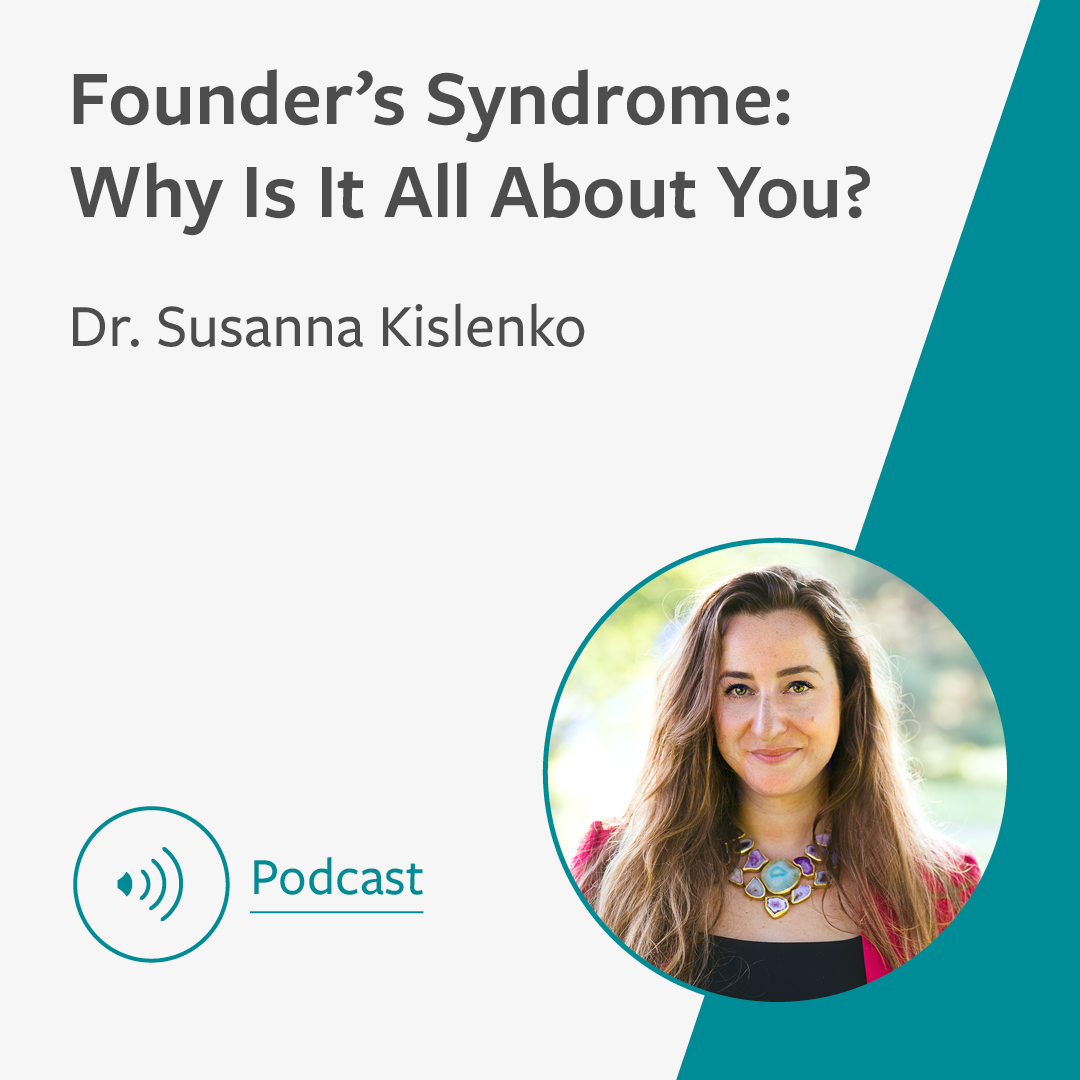
Author Bio: Dr Susanna Kislenko created and directs The Founder Leadership Research Lab based at Kellogg College at the University of Oxford, and Carleton University. She is also an Adjunct Research Professor at the School of Public Policy and Administration at Carleton University. As a social psychologist and an expert on long-term founder leadership, Dr. Kislenko investigates best practices around founder leadership, as well as its darker consequences including Founder’s Syndrome.